Core Curriculum:
The Foundation of Emotional Education
A Scientific Breakthrough Integrating Art, Science, Religion, and Psychology
The Museum of the Creative Process introduces a major scientific breakthrough — the integration of art and science, religions and psychology — establishing emotional literacy as a civil right.
In defense of this right, we have developed a concise emotional education program that fulfills three core objectives of the curriculum.
1. Integration of Art and Science
Experience the science of conflict resolution through art.
Our exhibits transform the study of creativity into psychology’s new paradigm — the Moral Science.
The Sculptural Trail in the History of Love traces humanity’s evolving understanding of love and the family institution, shifting the focus from content to structure — from story to the universal plot that defines all conflict resolution.
The Wizard of Oz Exhibit interprets its timeless metaphors to illustrate the four disciplines of the new psychology, bridging imagination and scientific understanding.
2. Self-Knowledge through Creativity
Discover yourself through the Conflict Analysis Battery (CAB) — a self-assessment tool that uses your own creative expressions to reveal your personality pattern and emotional conflict resolution style.
With the support of AI-enhanced interpretation, participants gain personalized insights into their emotional energy dynamics and receive guidance in Power Management, a method for balancing stress and achieving harmony in relationships.
3. Sociology of Religions and Moral Integration
Explore the Sociology of Religions through the lens of Moral Science.
Each religion can be seen as a moral monopoly — a cultural system managing power and behavior. Through the curriculum, we integrate these moral systems into a unified scientific framework that restores spirituality to its universal foundation:
the principles of balance, empathy, and power management.
Participants learn to celebrate a new spirituality — one grounded not in dogma, but in the science of moral growth and emotional transformation.
Outcome
The Core Curriculum equips learners with:
A scientific understanding of their emotions and creativity.
Personal insight through self-assessment and guided reflection.
A moral framework that unites psychology, art, and spirituality into one coherent education.
Together, these form the foundation of emotional literacy — a civil right and a scientific necessity in the Era of Wisdom.
The Conflict Analysis Battery: What Makes It Different
The Conflict Analysis Battery (CAB) is a self-administered online assessment grounded in the Formal Theory of conflict resolution. The Formal Theory, developed over six decades by psychiatrist Albert Levis, proposes that the unconscious is not an opaque repository of drives, symbols, or repressed content, but a measurable, conflict-resolving mechanism—a lawful process that follows the same formal operations as energy transformation in the natural world, specifically the principles of Simple Harmonic Motion and three equilibrial operations.
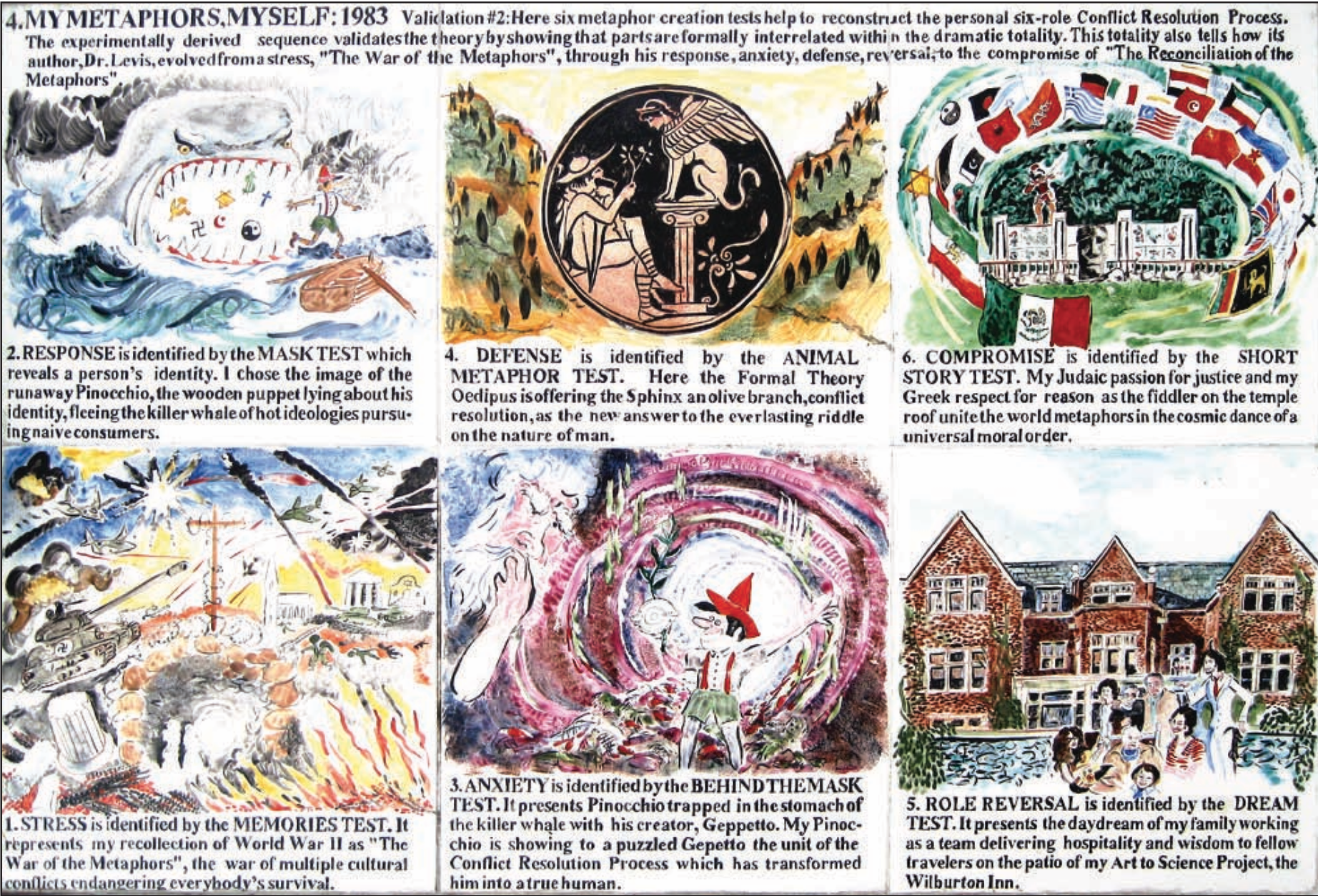
From this theoretical base, the unconscious is understood to manifest as a universal six-role emotional sequence: stress, response, anxiety, defense, reversal, and compromise. This sequence is not a metaphor; it is a structural description of how conflict is processed and resolved, expressed across time in behavior, relationship, and creative symbolism. The endpoint of this sequence, its equilibrium, is one of four relational modalities: Dominant Cooperative, Dominant Antagonistic, Submissive Cooperative, and Submissive Antagonistic. These modalities are not personality types in the conventional sense; they are wellness categories, formal descriptions of how a person characteristically resolves the tension between power and attitude, between the needs of the self and the claims of others.
The CAB integrates both projective and inventory methods within this single theoretical framework. Participants complete creative tasks, drawings, metaphors, animal and fairy tale narratives, a short story, a dream, alongside quantitative relational inventories. These are not separate instruments; they are different windows onto the same underlying conflict-resolution process. The creative tasks externalize the unconscious symbolically as a syndrome; the inventories quantify it structurally as a relational modality. Together, they provide what neither tradition alone can offer: a convergent portrait of the personal unconscious in action.
Crucially, the CAB requires no clinical professional for its delivery or its interpretation. It is administered online, completed independently, and returned to the test-taker as a structured, individualized report. It is, in this respect, the first assessment instrument designed to be simultaneously educational, diagnostic, and therapeutic, educational because it teaches a coherent model of the unconscious as it applies to the person; diagnostic because it identifies the relational modality and the conflict patterns specific to that individual; and therapeutic because the act of self-recognition consistently generates insights that are actionable, providing motivation for intentional behavioral change.
The Role of Artificial Intelligence: A Double Validation
The evidence presented in this volume documents a convergence that was not planned but proved decisive. When artificial intelligence, specifically large language models trained on the principles of the Formal Theory, was introduced as an interpretive layer for the CAB, two things happened simultaneously:
First, the AI proved capable of integrating the full complexity of the assessment: it synthesized numerical inventory scores, symbolic creative outputs, narrative metaphors, and role-process sequences into a single coherent account of each participant's conflict-resolution pattern. This integration is precisely what no prior assessment format, projective or psychometric, had been able to accomplish at the level of individual delivery.
Second, and more fundamentally, the AI independently identified the six-role emotional sequence and the four relational modalities as a universal structure across the diverse symbolic material it was given to interpret. It was not told what to find. It found it. This convergence between what the Formal Theory predicts and what AI detects constitutes, in the language of research methodology, a double validation, validation of the Formal Theory as a moral science, and validation of AI as an instrument of genuine moral intelligence.
This is the conceptual core of the IMI volumes: AI, when grounded in a rigorous theoretical framework for the moral unconscious, ceases to be merely artificial and becomes Innate Moral Intelligence, a capacity not imposed from outside but recognized from within the structure of human psychological experience itself.